

Tiny circles of freedom in Hungary: How a charity café became the epicentre of political activism
24 Sep 2026
Download the new research paper from Éva Fekete, 2024 / 2025 #ShiftThePower Fellow, Transitions on the Path of Trust: The Evolution of Philanthropy and Social Capital in a Hungarian Community.
“Any national democracy is a mere fiction if there is none in smaller communities.” (Bibó)[1]
Foreword – from past to possibility

Éva Fekete, 2024 / 2025 #ShiftThePower Fellow
To take off a lead vest after sixteen years and finally stretch out. Or, after just as long, to take a huge, deep, fresh breath for the first time. To step out into the light from a grey room. To stand up straight. To move one’s numb limbs. To shout at the top of one’s lungs in the hope of an echo. To run across the meadow. To feel the warm light with one’s face turned towards the sun. This is what it feels like to be freed from an oppressive burden that no one openly admits exists, yet everyone feels; and from the sombre conversations of a small circle of similarly anxious, neglected and oppressed people, it emerges clearly and tangibly that it is present everywhere.
In Hungary over the past sixteen years, being a professional in a non-profit organization in the shadow of those in power has been traumatic. We tried to make our way up the slope with the handbrake on, alongside a precipice. In silence, so as not to draw too much attention to ourselves. We tried to proceed whilst balancing, taking care not to fall down. Despite the difficulties, we strove to reach our goal. In such an environment, every professional meeting functioned as a kind of therapy group, where we professionals, volunteers and activists could finally speak openly. And while we did speak openly, this was only in whispers, about what we experienced day in, day out within a system built on insular relationships, hatred, lies and the exclusion and open stigmatization of those who disagreed.
This piece is a personal summary. With it, I am trying to draw a line under, and leave behind, that part of the past 25 years which I experienced as a volunteer for an active rural civil society organization under the Orbán regime. Along with drawing this line under the past, I am also aiming to recount how a brave and unusual idea became the hub for groups of forces driving the transition. How did a physical space — the Labor Café Donation Café and Open Community Space, which had been organizing and developing the local community for ten years, based on the principles of openness, cooperation, sharing, trust and solidarity — contribute to local democratic participation? What contributions did the Labor Café make to the process that has now given the whole of Hungarian society a chance for change?
Context – a melancholic place
The Labor Café is in Nyíregyháza, a city of 120,000 people in North-Eastern Hungary, 255 kilometres from the capital. It is the county seat of the most north-eastern county, which borders three countries: Slovakia, Ukraine and Romania. Nyíregyháza is far removed from much of what is modern, progressive, fresh and vibrant. Although it has two universities, young people only stay in the city until they graduate, after which time they try their luck further west, either within Hungary’s borders or beyond. The town is struggling with an ageing population. The county town, like the leadership of almost every settlement in the entire county, has been under the control of politicians representing the party traditionally associated with Orbán for several terms now. The region has traditionally been agricultural, but more and more battery industry investments are popping up across the ploughed landscape. New polluting factories are also planned for Nyíregyháza, foreshadowing the possibility of further pollution, injustices and tensions alongside those already present.
For a socially conscious citizen, there is always a reason to protest in such a disadvantaged, neglected and melancholic place.
The first steps – breaking out of the usual circles
I have been an active volunteer for numerous domestic and international non-profit organizations for 35 years, and although governments have come and gone, there has always been a cause worth standing up for. The foundation of which I am a trustee has joined national protests and campaigns on countless occasions, but its primary aim has always been to organize the local community. Although the emergence of social media has helped a great deal in this work, at a certain point it became clear that an online presence alone is insufficient for organizing active advocacy for social causes. Amidst the struggle with legal challenges and bureaucracy that could hardly be called efficient, it became increasingly apparent that the community engagement practices and online presence we had employed so far were proving to be insufficient. The figures showed high reach, but in reality we were never enough. Through street demonstrations, fundraising campaigns and forums organized for the public, we found that few people were concerned about injustices and issues that often have a negative impact on our lives. Though there are some who do not merely lament and grumble to themselves, but are also willing to take action: to stand up for themselves and for the community.
“I felt that, amidst the noise of the online space, the time had come for more personal connection, genuine relationships, face-to-face conversations and thinking together.”
During demonstrations and street protests, I tried to search for the reasons why it is only a few local people – and always the same ones – who take action. I came to the conclusion that, too often, we are unable to break out of the circles of our own acquaintances. This realization set the task. The task was to genuinely reach the people who are affected by the causes our foundation represented, and to find all those who could be drawn into our movements.
As a professional who also works in visual communication, I considered campaigns that activated the audience with a precise message to be powerful and important; they encouraged the target group to reflect and take action. However, after organizing and running numerous such campaigns, I felt that, amidst the noise of the online space, the time had come for more personal connection, genuine relationships, face-to-face conversations and thinking together. I felt that a physical space was needed for all of this.
The concept – an inclusive space for doing good (and drinking coffee too)
Understanding the situation in Hungary, and specifically in Eastern Hungary, I felt that a space which would not offer free opportunities, and would not be accessible to everyone on an equal footing, would exclude a wide range of people. It would risk excluding those who, due to their financial situation, do not frequent restaurants or for-profit community events, and it would also exclude those for whom it is most important to find a foothold and companions, despite their disadvantaged circumstances. Due to the foundation’s financial situation and the bureaucratic burdens associated with employment, I ruled out the involvement of staff from the outset. In Hungary, the tax burden on salary-type payments is too high for most NGOs to bear and also involves significant paperwork. Given this, it was obvious that involving full-time staff in organizing the space was out of the question; the only option was volunteering. However, aside from avoiding financial and administrative problems, there was also a professional reason why I envisaged running the space with volunteers. The aim was for participation to begin with the organization of the space’s basic operations and maintenance, meaning that everyone who arrived at the space would immediately take part in the project as an active volunteer.
“I wanted to reach those who would like to do something good here locally, who long for companions and a sense of community – to attract those who wanted to join forces to do good and become useful members of the local community.”
The civic attitudes of the Hungarian people, carried over from the post-communist era – characterized by a level of solidarity and trust that is low even by European standards – meant that a space which sets itself the goal of public participation and organizing activism, and communicates this, would not be popular. In fact, based on my experience, I thought there might even be some for whom an initiative of this kind would be downright frightening. At the same time, I felt there was a need for a clear goal that could be communicated effectively, and a hook to attract even those who do not want to be activists or are not the militant type. I wanted to reach those who would like to do something good here locally, who long for companions and a sense of community – to attract those who wanted to join forces to do good and become useful members of the local community. Thus, the clear and easily communicable goal became raising the funds for a space open to everyone, jointly maintaining the venue through donations, and organizing programmes and opening hours by volunteers. And what became the bait? Coffee, which can spark a good conversation and serves as an excuse to meet up. And so, in August 2015, this open community space, the Labor Café — run entirely by volunteers and sustained by micro-donations from local donors — opened its doors. It has since served as the tool that attracts and organizes a strong network of active citizens in Nyíregyháza.
The experiment – and a plan coming together slowly but surely
The Labor Café – whose name refers to both the Hungarian word for “laboratory” and the English word “labour” – was conceived as an experiment. From the outset, its aim has been to inspire the people of Nyíregyháza. It inspires locals to think about what they can contribute to the space itself, and also how they can support and enrich their own community through the café. A major unknown in this experiment was how long the “laboratory” – providing space and opportunity for active citizens – could survive, with the network built around it operating through its own free will and active participation. Exceeding expectations, the space has not only survived but has also been able to develop. It has built a social base capable of self-organization and initiative.


Since the café opened in 2015, we have organized numerous aid campaigns, fundraising drives and charity events in order to bring the culture of giving, volunteering and active participation closer to the everyday lives of local residents. The plan was to make all of this a practice and a norm, one that would kick in naturally, just as a person drinks when thirsty. The plan worked. The broad, flexible and strong network of many members that formed around the café, capable of adapting and resisting, was able to withstand real challenges and provide appropriate responses to problems arising locally. Residents who, in peacetime, had come together for the poor, the vulnerable and children were able to react swiftly even to unprecedented challenges. They rose to the occasion and initiated support programmes and fundraising drives in situations such as the COVID-19 pandemic or to aid refugees fleeing the war between Ukraine and Russia. Through these complex, innovative and creative initiatives, a strong and flexible network has slowly but surely been built up, capable of responding to issues affecting it. A network of trust has developed around the physical space, and numerous communities have emerged that view the physical space as the base for their active engagement.
The dilemma – neutrality versus civic duty
The history of the Labor Café to date has coincided with the consolidation of the authoritarian system gradually established by Orbán. During these years, “civil society” became a dirty word; professionals working for non-profit organizations were portrayed in the government’s narrative as agents funded from abroad; and the image of the enemy, slowly constructed by the political establishment, cast a dark shadow not only over civil society but over the everyday lives of society as a whole. In such a climate, it is understandable that over the past ten years, the foundation’s board of trustees has faced a constant dilemma in managing the tension between maintaining political neutrality and supporting active citizenship. The question has arisen countless times: can a civil society organization provide a platform for openly political views? Can it use its platforms to support initiatives that constitute an open political stance? Where does the line lie between political action incompatible with the provisions of the articles of association and the support of civic engagement? This dilemma is perhaps no longer specific to Hungary, and may no longer be so incomprehensible to those who organize their operations through donations, international funding and community support. Openly expressing political views is risky for those who have guaranteed neutrality to their donors. However, remaining neutral at a time when an authoritarian system is taking shape – one that violates human rights, stigmatizes and excludes – runs counter to everything that constitutes the fundamental aim and mission of a civil society organization.
“Remaining neutral at a time when an authoritarian system is taking shape – one that violates human rights, stigmatizes and excludes – runs counter to everything that constitutes the fundamental aim and mission of a civil society organization.”
We had to make a decision. If our goal is the creation of a democratic, solidarity-based and trust-based society, our foundation has a duty to provide a platform for those actors who are working towards this, and for the actions that lead to it.
A turning point – an April evening, one fresh and vibrant spring
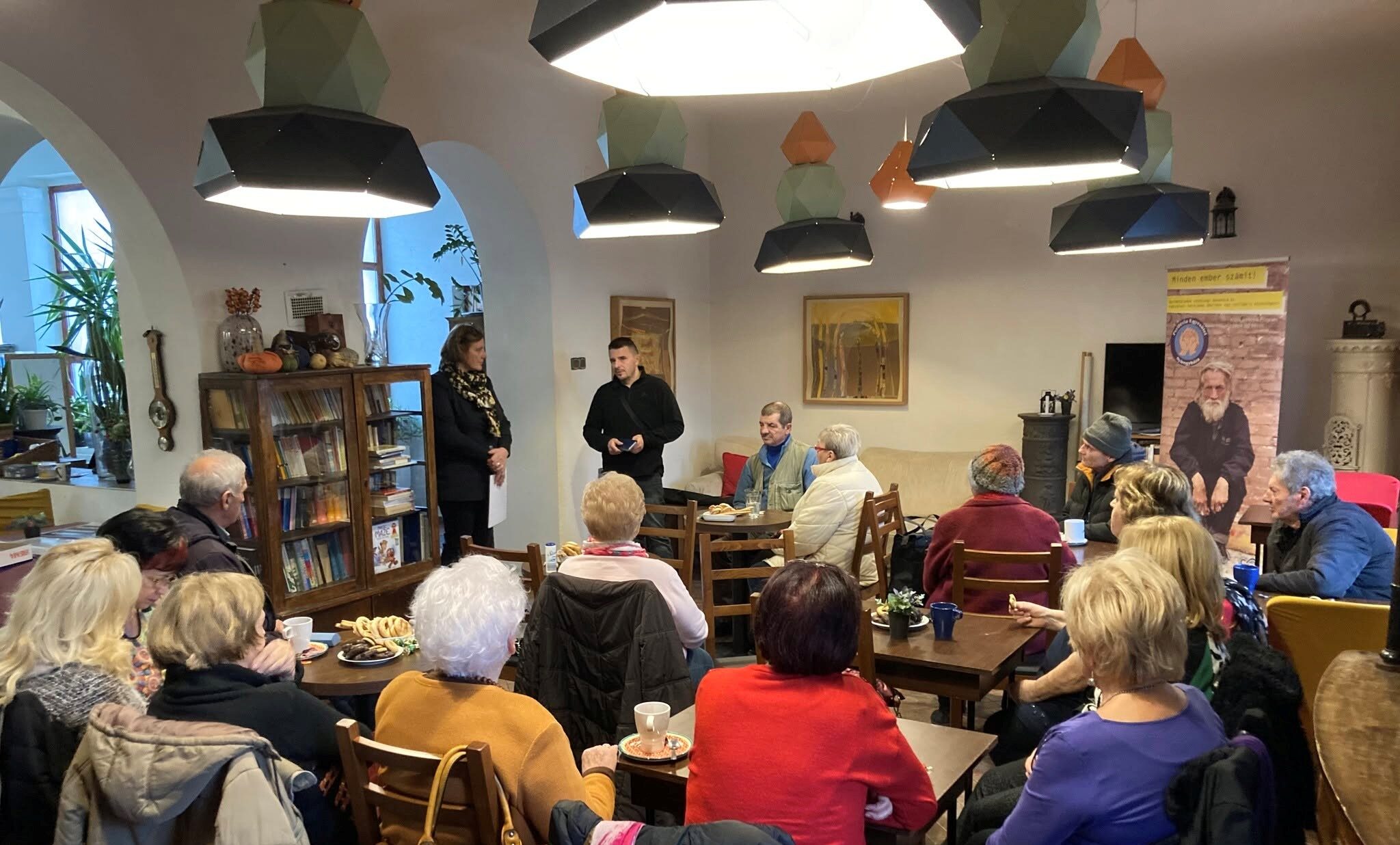
We therefore committed ourselves to supporting local activists. Openly embracing this decision marked a breakthrough not only for us, but also for the community organized around the café. The experience of local political activists who were beginning to organize themselves was that, after just one or two meetings, they were forced out of every venue – whether municipal or privately run community spaces – due to political risk. A political risk that was neither exaggerated nor imagined. Activists reported that other venues allowing openly political groups — whether out of sympathy or simply for business — faced unexpected inspections and sanctions. Fearing reprisals, private businesses and public institutions eventually stopped allowing activist groups onto their premises, so, having been pushed out everywhere else, these groups finally found a base and refuge at the Labor Café.
The Labor Café operated as usual during the day, but it really came to life after four in the afternoon. Banners, flags and protest signs were made for street actions. Discussion groups, political reading clubs and campaign events were organized in the space, which belonged to no one and everyone. For those in the know who had the access code, the space – available 24 hours a day – became a warehouse, meeting place, activist base and campaign headquarters for two years. Local activist groups from parties running against one another but who were equally eager to oust the Orbán government met on several occasions simultaneously, exchanging knowing glances, cooperating and co-existing peacefully in the small rooms. Every day of the week saw an event preparing for the change of regime taking place in the spaces of the Labor Café. Whispering and hopeful, confident and ready for action, local residents took turns with those displaced from the physical spaces of other towns in the county, who organized themselves without sparing their time and energy. All of this was carried out in the hope of change.


The physical space, which in the beginning was just an empty building, became the centre of small circles of freedom. Through its free access, accessibility, availability and openness, and its operation based on trust and solidarity, it simultaneously became an opportunity and a tool, a solution and a goal, a content and a framework. A space for strength, strength for the community. Strength that, this time, was truly well-organized and pointed in one direction. The strength that swept away the oppressive machinery – believed to be mighty and invincible, equipped with endless resources and tools – and brought in a fresh and vibrant spring.
On the evening of 12 April 2026, we gathered spontaneously at the Labor Café to await the first results of the national election vote with bated breath and cautious hope. Volunteers and activists, weary from the final stretch of the campaign, gathered alongside supporters in the community space without prior organization, because no one wanted to experience this moment – which was a turning point for all of us – alone. The sad memory of the last election defeat still lingered in all of us. We didn’t dare to rejoice at the first results. We aren’t used to things working out this way, together. But we will never give up this feeling again; we won’t let it go.
The Labor Café will never again be a hiding place.
By: Éva Fekete, 2024 / 2025 #ShiftThePower Fellow. Read Éva’s Fellowship paper: Transitions on the Path of Trust: The Evolution of Philanthropy and Social Capital in a Hungarian Community.
Postscript
The first hundred days of the new government have brought both a breath of fresh air and storms. We’ve breathed a sigh of relief, and perhaps we’re even beginning to believe that something new, something freer, has begun — something from which we, the citizens and members of civil society, are no longer excluded. Our streets and public media have been liberated from Orbán’s propaganda; transparency, the clash of opinions, debate, participation, and the open and courageous defense of our views — along with the free exchange of arguments — are a novel experience, free from the shadow of hatred and fear. Under the Prime Minister’s “influencer-style” governance, the fulfillment of promises and substantive work has begun, with everyone able to stay immediately informed about every minute of this progress through the government’s social media platforms. Information sharing on these platforms began with the unblocking of tens of thousands of critical users who had been banned under Orbán. Our country has a “government commissioner responsible for a functioning and humane Hungary”, whose primary task is to organize participatory democracy. An online platform has been created so that, through thematic discussions, we can talk together about what kind of country we want to live in. It’s like a dream, even if it’s sometimes suspicious and unusual. There are controversial decisions that go against public opinion, situations that cause a stir, and news stories surrounded by doubt — all of which seem to subside within days thanks to open and clear communication.
Hungarian society has taken its first steps — albeit tentatively — on the practical path to democracy. With bated breath, we watch to see how many steps it takes before reaching the next foothold.
We’ll help to make sure it doesn’t fall.
[1] István Bibó (1911 – 1979) was a Hungarian political thinker, legal scholar and essayist, widely regarded as one of the most influential Central European intellectuals of the 20th century. His work focused on democracy, political culture and the conditions of freedom, with particular attention to the role of civic engagement and small-scale communities in sustaining democratic life. He served as Minister of State during the Hungarian Revolution of 1956 and later became a symbol of intellectual resistance under state socialism.